
Swimming looks like the safest sport on the schedule. No contact, no cleats, no collisions. But ask any competitive swimmer’s shoulder how many strokes it takes in a single practice, and you’ll understand why shoulder pain is the most common injury in the sport. A swimmer training year-round can rack up tens of thousands of overhead rotations a week, and the shoulder is the joint absorbing almost all of it.
Swimmer’s shoulder isn’t one injury. It’s an umbrella term for a handful of overuse problems that build slowly in the same joint, usually starting quietly and getting ignored because the swimmer can still finish the set. Here’s what’s actually happening in the shoulder, what to watch for, and how to keep your athlete in the water instead of on the deck.
Why Swimmers Are So Prone to Shoulder Problems
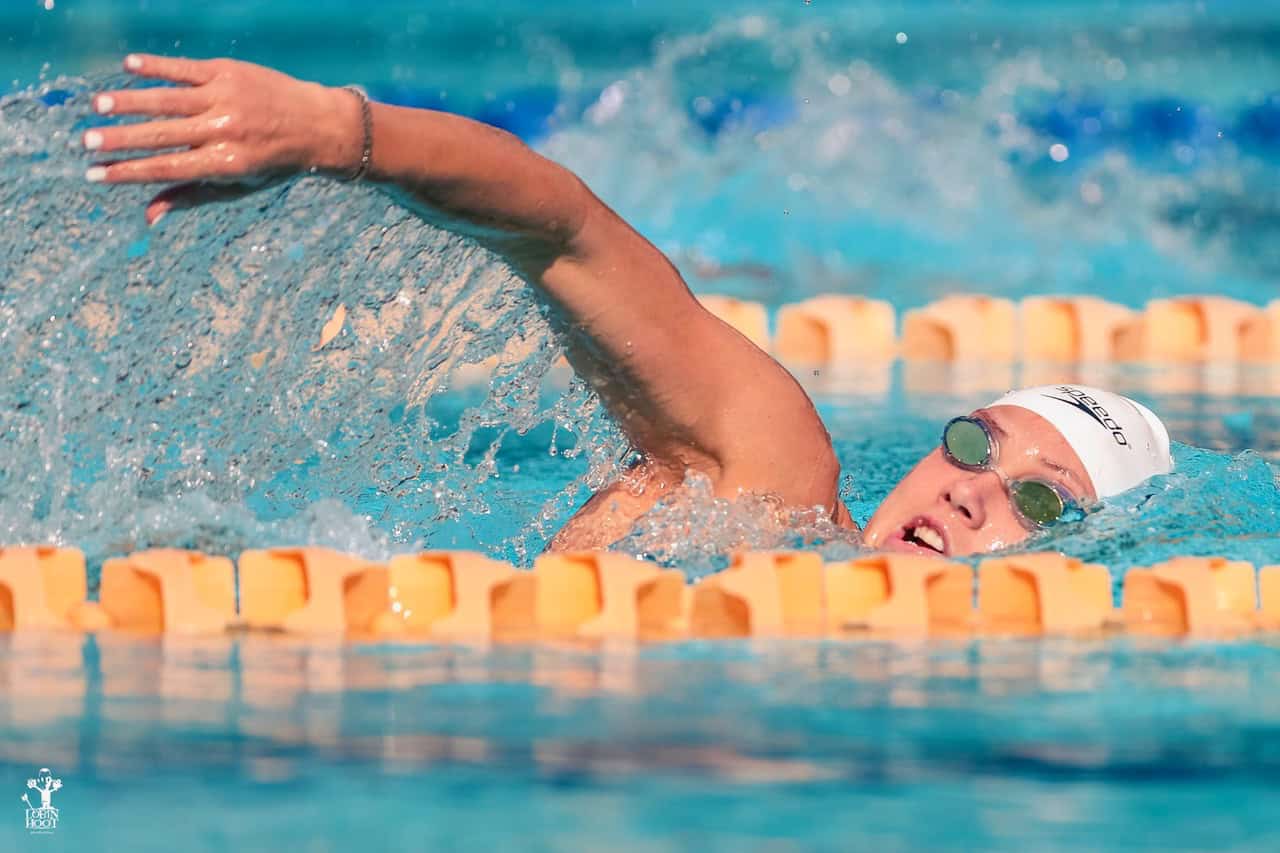
Every competitive stroke except breaststroke relies on a repeated overhead motion, and freestyle and butterfly put the shoulder through its full range thousands of times in a single practice. Multiply that by six days a week, multiple sets a day during peak season, and years of year-round training, and the shoulder is doing more repetitive work than almost any other joint in youth sports.
The shoulder is also built for mobility, not stability. It’s a shallow ball-and-socket joint held together mostly by muscles, tendons, and ligaments rather than bone. That’s what gives swimmers their huge range of motion, but it also means the joint depends entirely on strength and control to stay stable under that kind of repetitive load. When training volume increases faster than that strength does, the joint starts to break down.
What’s Actually Happening in the Joint
Swimmer’s shoulder usually involves one or more of three overlapping problems, and they tend to feed each other once they start.
- Impingement: repeated overhead motion can cause the rotator cuff tendons to get pinched between the arm bone and the top of the shoulder blade with every stroke, leading to irritation and inflammation over time
- Rotator cuff overload: the small muscles and tendons that stabilize the shoulder fatigue faster than the larger muscles driving the stroke, so they take on more stress than they’re built for as a set or a season goes on
- Scapular instability: weakness in the muscles that control the shoulder blade lets it move out of proper position during the stroke, which throws off shoulder mechanics and increases stress on everything downstream
None of these show up as one sharp moment of injury. They build across weeks of practice, which is exactly why so many swimmers train through the early stages without realizing anything is wrong.
Early Warning Signs Swimmers Tend to Push Through
Competitive swimmers are conditioned to push through discomfort, and shoulder pain in particular gets normalized as just part of the sport. That mindset is exactly why early signs get missed until the injury is harder to fix.
- A dull ache in the front or side of the shoulder that shows up partway through practice
- Pain during specific parts of the stroke, especially the catch or the recovery phase
- Shoulder pain that lingers into the next day instead of fading with a warm-up
- A noticeable drop in stroke count efficiency or a change in how the stroke feels
- Clicking, catching, or a sense of weakness when reaching overhead
Any of these is a reason to flag the shoulder to a coach and get it looked at, not a reason to swim through it and hope it settles on its own.
Training and Technique Adjustments That Protect the Shoulder
Most swimmer’s shoulder cases are preventable with the right balance of load and support work, not less swimming altogether.
- Build dedicated rotator cuff and scapular strengthening into dryland training, not just core and leg work
- Have a coach periodically check stroke technique, since small breakdowns in catch mechanics or body rotation add stress to the shoulder without the swimmer noticing
- Manage total yardage increases gradually, especially at the start of a new season or after a break
- Prioritize a real warm-up and cooldown instead of jumping straight into main sets
- Build in true rest days where the shoulder isn’t doing any overhead work, including weight training
Our team works directly with club and high school swimmers on shoulder strength programs built around actual training volume, not a generic off-season plan.
When Rest Alone Isn’t Enough
Backing off yardage for a few days can help with mild, early soreness, but it doesn’t fix the underlying strength or mechanics problem that caused the pain in the first place. A swimmer who rests, feels better, and returns to full volume often ends up right back where they started within a few weeks.
If shoulder pain has lasted more than a week or two, keeps coming back once training resumes, or is changing how your swimmer moves through the water, it’s time for an actual evaluation. That means a hands-on look at shoulder strength, scapular control, and stroke mechanics, followed by a specific plan instead of a guess.
Caught early, swimmer’s shoulder is usually a manageable fix: targeted strengthening, a technique adjustment or two, and a smart return-to-yardage plan. Ignored, it can turn into a shutdown that costs an athlete an entire championship season.