

Back-to-school doesn’t mean back-to-normal for a lot of young athletes anymore. Club season overlaps with school tryouts. Travel tournaments stack up every weekend. The off-season that used to exist between sports has quietly disappeared for kids who specialize early.
That schedule is a big reason we see so many overuse injuries walk through our doors every fall. These aren’t dramatic, sideline-stretcher injuries. They build slowly, get ignored, and then sideline an athlete for months instead of weeks. Here’s what’s actually driving the trend, what to watch for, and how to build recovery back into a training year without sitting your athlete out for the season.
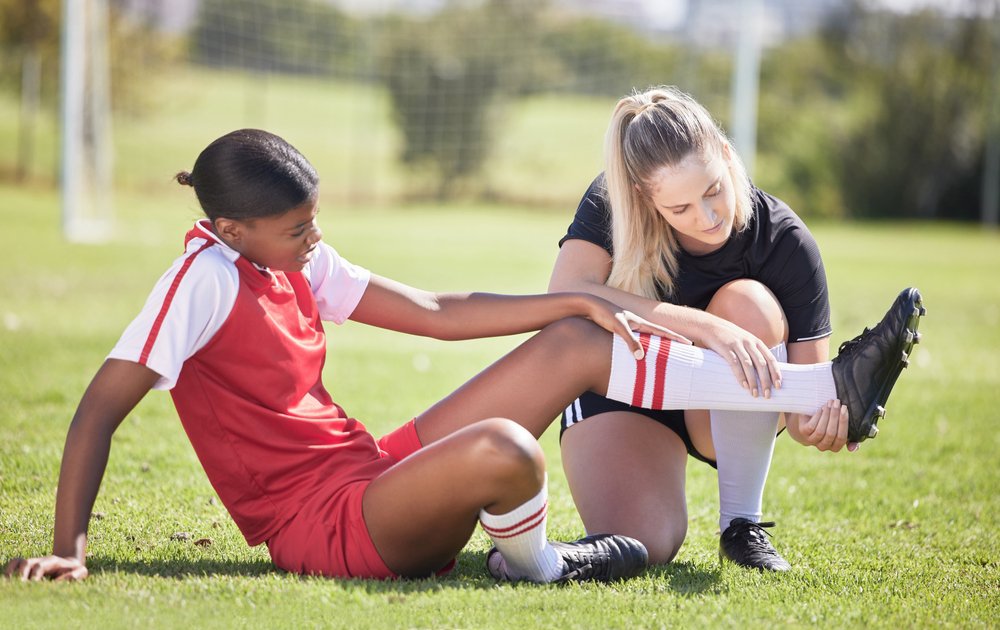
What Actually Counts as an Overuse Injury (vs. an Acute Injury)
An acute injury happens in one moment: a rolled ankle, a torn ACL, a collision on the field. You know exactly when it happened because you saw it or heard it.
An overuse injury is different. It’s damage caused by the same motion repeated thousands of times without enough recovery in between, whether that’s a pitching arm, a running stride, or a jumping knee. There’s no single moment you can point to, just soreness that shows up, gets brushed off, and slowly gets worse. Stress fractures, tendinitis, and growth plate irritation all fall into this category, and they’re tied to how a season, or a year, is structured, not to one bad play.
Why Single-Sport Specialization Is Fueling the Rise
Kids used to rotate through sports by season: football in the fall, basketball in the winter, baseball in the spring. That naturally spread stress across different muscle groups and movement patterns.
Now it’s common for a young athlete to pick one sport by age nine or ten and play it almost year-round: school season, club season, travel tournaments, and private training layered on top with barely a break between them. The same joints and growth plates absorb the same repetitive stress, week after week, month after month. A growing skeleton doesn’t recover like an adult’s does; growth plates are softer and more vulnerable to repetitive load than the surrounding bone. Combine that with sport-specific training year-round, and specialization stops being a competitive advantage and starts being a structural risk. We see this pattern constantly with the young athletes who train near our 14 locations across Texas, where club soccer and swim schedules run close to twelve months a year.
Common Overuse Injuries by Sport
Different sports load the body differently, so the overuse patterns look different too:
- Runners and cross country athletes: stress fractures in the shin (tibia) or foot from repeated impact without enough recovery between hard efforts.
- Throwers (baseball, softball) and jumpers (volleyball, basketball): tendinitis in the shoulder, elbow, or knee, including what’s often called Little League elbow and jumper’s knee (patellar tendinitis).
- Growing athletes in running and jumping sports: Osgood-Schlatter, an irritation of the growth plate just below the kneecap that’s common during growth spurts in early-to-mid puberty.
- Swimmers and gymnasts: shoulder impingement and wrist stress from repetitive overhead or weight-bearing motion.
Each of these starts small. Left alone, none of them stay that way.
Warning Signs That Get Ignored Until It’s Serious
Overuse injuries rarely announce themselves. They creep in, and most kids downplay pain because they don’t want to sit out a game. Watch for:
- Pain that shows up at the same point in practice every time, then starts showing up earlier and earlier.
- Soreness that doesn’t fully resolve with a day or two of rest.
- A visible change in mechanics, like a shorter stride, an altered throwing motion, or favoring one leg.
- A drop in performance that doesn’t match effort or fitness level.
If your athlete says “it’s fine” but you notice any of the above, trust what you’re seeing over what they’re saying. Kids consistently underreport pain when a starting spot or a tournament roster is on the line.
Building Real Recovery and Cross-Training Into a Training Schedule
None of this means pulling your kid out of competitive sports. It means building recovery into the calendar the same way you build in practice and games.
- Take two to three months off each year from sport-specific training. This doesn’t mean stopping all activity, but rather giving your body a break from repetitive movements.
- Use cross-training to work different muscle groups and movement patterns between seasons.
- Treat scheduled rest days as non-negotiable, not optional extras that get skipped when a tournament comes up.
- Build in strength and mobility work targeted at the joints your athlete’s sport stresses most.
Parents and coaches heading into fall frequently ask us for this kind of plan: a way to keep competing hard without training year-round on the exact same tissue.
When an Overuse Injury Needs Evaluation, Not Just Rest
Rest helps, but it isn’t a diagnosis. If pain persists beyond a few days of modified activity, keeps returning once your athlete goes back to full training, or is sharp and localized to one specific spot, it needs a real evaluation, not just more time off.
A stress fracture that gets missed and played through can turn into a full fracture. Tendinitis that’s ignored can become a chronic problem that follows an athlete into college sports. The earlier we look at it, the shorter the recovery and the fewer games your athlete actually misses.